
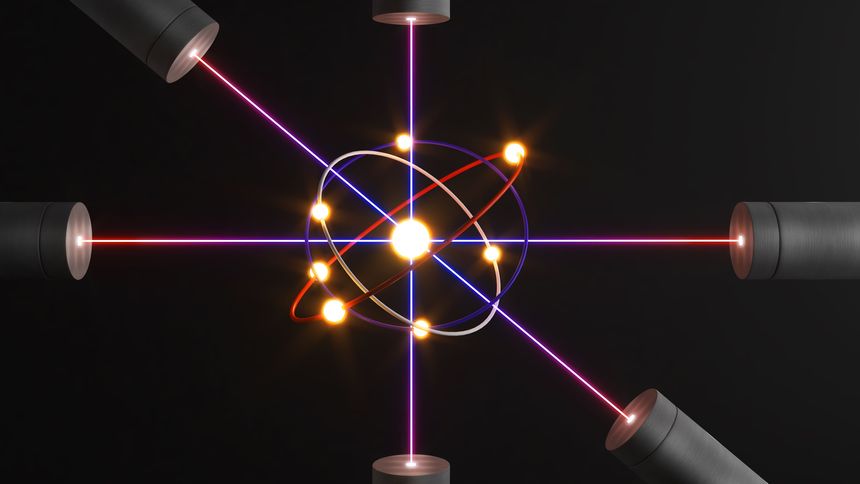


The German Federal Government has published a draft bill to amend the Radiation Protection Act (Strahlenschutzgesetz, “StrlSchG”), which for the first time explicitly clarifies the regulatory framework applicable to fusion facilities — including laser fusion plants. For companies developing fusion technology in Germany, the bill delivers two key messages: fusion plants will be permitted under the StrlSchG — not under the more onerous Atomic Energy Act (Atomgesetz, “AtomG”) — and the permitting process itself is being significantly streamlined.
Permitting under Radiation Protection Law
The draft bill expands the definition of “facilities for the generation of ionizing radiation” in Section 5(2) StrlSchG to explicitly include fusion facilities (Fusionsanlagen) alongside accelerators, plasma installations, and laser installations. This clarification confirms what the government views as existing law but had not been expressly stated: fusion facilities are subject to the permitting requirements of the StrlSchG — not of the AtomG.
Germany’s legislative rationale emphasizes the fundamentally different risk profile of fusion compared to fission: fusion does not produce long-lived radioactive isotopes (when suitable materials are selected), carries no risk of uncontrolled chain reactions due to the physical properties of the fusion process, and involves a significantly lower inventory of radiotoxic substances. The government explicitly states that radiation protection law provides an “appropriate and safe framework” for the construction and operation of fusion facilities, consistent with international and European regulatory standards.
Why this matters: For startups working on the development of laser fusion technology and project developers, the permitting regime is a decisive factor. The AtomG regime — designed for nuclear fission — imposes far more intensive licensing procedures, political considerations, and public participation requirements. Confirmation that fusion facilities fall under the StrlSchG establishes a fundamentally more proportionate and predictable regulatory pathway.
The “Once-Only Principle” and Leveraging Pre-Application Dialogues
The draft bill introduces the "Once-Only Principle" (Once-Only-Prinzip) across all notification and permit proceedings under the StrlSchG. In practice, this means: applicants in any permit or notification procedure may refer the competent authority to documents and evidence that they have already submitted to the same authority, to the extent those documents are identical to what would otherwise need to be filed again. This allows applicants to avoid re-submitting documents that are relevant to the current proceeding but already known to the authority.
Why this matters: Startups and project developers who engage in pre-application dialogues with the radiation protection authority — for example, to discuss site selection, technology parameters, or safety concepts before formally filing — will be able to leverage those interactions in the formal permit process. Documents provided during such dialogues do not need to be re-submitted. This reduces the time and cost of the formal permitting procedure once an application is filed.
Further Procedural Simplifications
Beyond the Once-Only Principle, the bill introduces additional measures that will benefit fusion project developers:
Elimination of mandatory time limits on permits: The mandatory statutory limitation of certain permits to five years is abolished. Authorities retain discretion to impose time limits where appropriate, but permits may now be issued for an indefinite period.
Digitalization of administrative procedures: Written-form requirements are eliminated across most proceedings, allowing electronic submission of applications and notifications.
Outlook
The bill implements Germany's Action Plan "Deutschland auf dem Weg zu einem Fusionskraftwerk" and is designed to provide the legal certainty and regulatory clarity needed to encourage research, development, and commercial investment in fusion. For start-ups and project developers working toward commercial laser fusion plants, this draft legislation marks an important milestone: it confirms a proportionate regulatory home for fusion, streamlines the permitting process, and rewards early regulatory engagement.
/Passle/679a45206a5d021bf4d2f921/SearchServiceImages/2026-09-10-16-36-03-200-6aa2dc73ff5bd9fb0fefbf5d.jpg)
/Passle/679a45206a5d021bf4d2f921/SearchServiceImages/2026-09-02-02-24-06-259-6a9788c6406533fea8d5114b.jpg)
/Passle/679a45206a5d021bf4d2f921/SearchServiceImages/2026-09-01-15-49-44-529-6a96f418f9386af8ea6fbda3.jpg)