
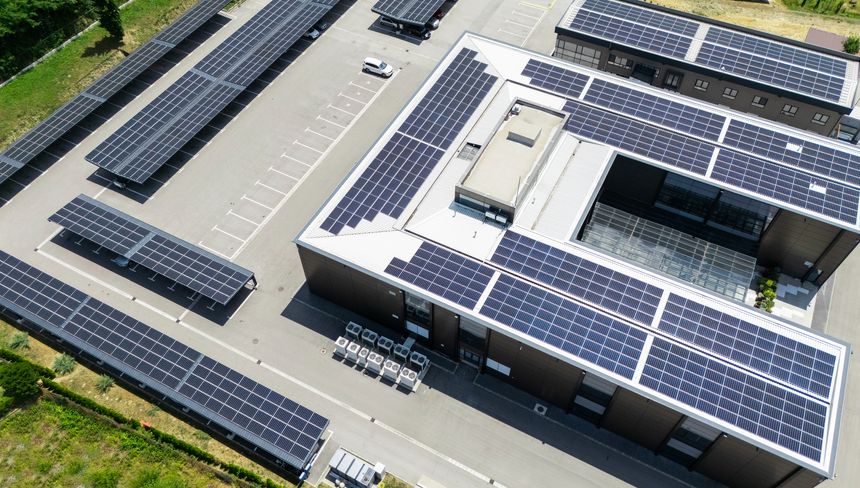


Germany is introducing nationwide requirements for solar installations on buildings, with the first obligations taking effect on January 1, 2027. The new rules form part of Germany's recently adopted Building Modernization Act (Gebäudemodernisierungsgesetz, “GModG”) and implement requirements under the EU Energy Performance of Buildings Directive (Directive (EU) 2024/1275, “EPBD”).
While several German states already impose solar requirements, the new Section 106 GModG establishes a federal framework that will gradually extend to different categories of buildings between 2027 and 2031.
A Phased Rollout Starting in 2027
The new requirements will apply in several stages:
- January 1, 2027: New public non-residential buildings and new non-residential buildings with more than 250 square meters of usable floor area must be equipped with solar installations.
- January 1, 2028: The requirement extends to existing public non-residential buildings exceeding 2,000 square meters and, subject to certain conditions, existing non-residential buildings exceeding 500 square meters undergoing major renovations.
- January 1, 2029: Existing public non-residential buildings exceeding 750 square meters become subject to the requirement.
- January 1, 2030: New residential buildings and new covered parking areas physically adjacent to buildings are included.
- January 1, 2031: The threshold for existing public non-residential buildings drops to 250 square meters.
In addition to the installation requirements set out above, Section 106(1) GModG imposes a design obligation on all new buildings. Accordingly, new buildings must be designed to optimize their potential for generating solar energy based on the solar irradiance of the site and to facilitate the cost-effective installation of solar technologies. By imposing this obligation, the legislator aims to ensure that new buildings are solar-ready from the outset.
Not Just Rooftop Photovoltaics
The federal requirement is deliberately technology-neutral. According to the legislative materials, “solar energy installations” include both photovoltaic and solar thermal systems.
Nor must the installation necessarily be located on the roof. Consistent with the EPBD, the concept of “on-site” solar energy extends to installations in or on the building or elsewhere on the property on which the building is located. This may provide developers and property owners with additional flexibility when integrating solar generation into larger sites.
The obligation is subject to exceptions where installation is technically impossible, functionally unfeasible, economically unreasonable, or conflicts with other public-law requirements. How these exceptions will be interpreted in practice will likely become an important issue as the new requirements begin to apply.
German Federal Rules Do Not Replace State Requirements
For companies with real estate portfolios across Germany, one important complexity remains: The GModG expressly allows Germany's federal states to maintain or introduce more stringent solar requirements.
The federal rules therefore establish a nationwide baseline rather than a fully harmonized regime. Existing and future state legislation will need to be assessed alongside Section 106 GModG. This is particularly relevant from an enforcement perspective: While the GModG does not impose an administrative fine for breaches of the new federal solar requirements, certain state regimes provide for significant penalties. In Berlin, for example, violations of the state solar requirement may result in fines of up to EUR 50,000 for non-residential buildings. The absence of a federal fine does not, however, leave Section 106 without enforcement: Under Section 95 GModG, the competent authorities may order the measures necessary to ensure compliance with the solar requirements. Non-compliance with such an enforceable order may constitute an administrative offense subject to a fine under Section 108 GModG, thereby providing an indirect enforcement mechanism.
Why This Matters
The first compliance date is only months away. Developers planning new non-residential projects with more than 250 square meters of usable floor area should therefore incorporate the new solar requirements into project design and permitting processes now.
The implications extend beyond new developments. Companies planning significant renovations of larger commercial properties should assess whether their projects may trigger the requirements applying from 2028. Owners and investors should also review portfolios across different German states, as more stringent state-level requirements may continue to apply.
The new rules therefore make solar compliance an increasingly relevant consideration not only for ESG and energy strategies, but also for real estate development, permitting, and transactional due diligence.
/Passle/679a45206a5d021bf4d2f921/SearchServiceImages/2026-09-10-16-36-03-200-6aa2dc73ff5bd9fb0fefbf5d.jpg)
/Passle/679a45206a5d021bf4d2f921/SearchServiceImages/2026-09-02-02-24-06-259-6a9788c6406533fea8d5114b.jpg)
/Passle/679a45206a5d021bf4d2f921/SearchServiceImages/2026-09-01-15-49-44-529-6a96f418f9386af8ea6fbda3.jpg)